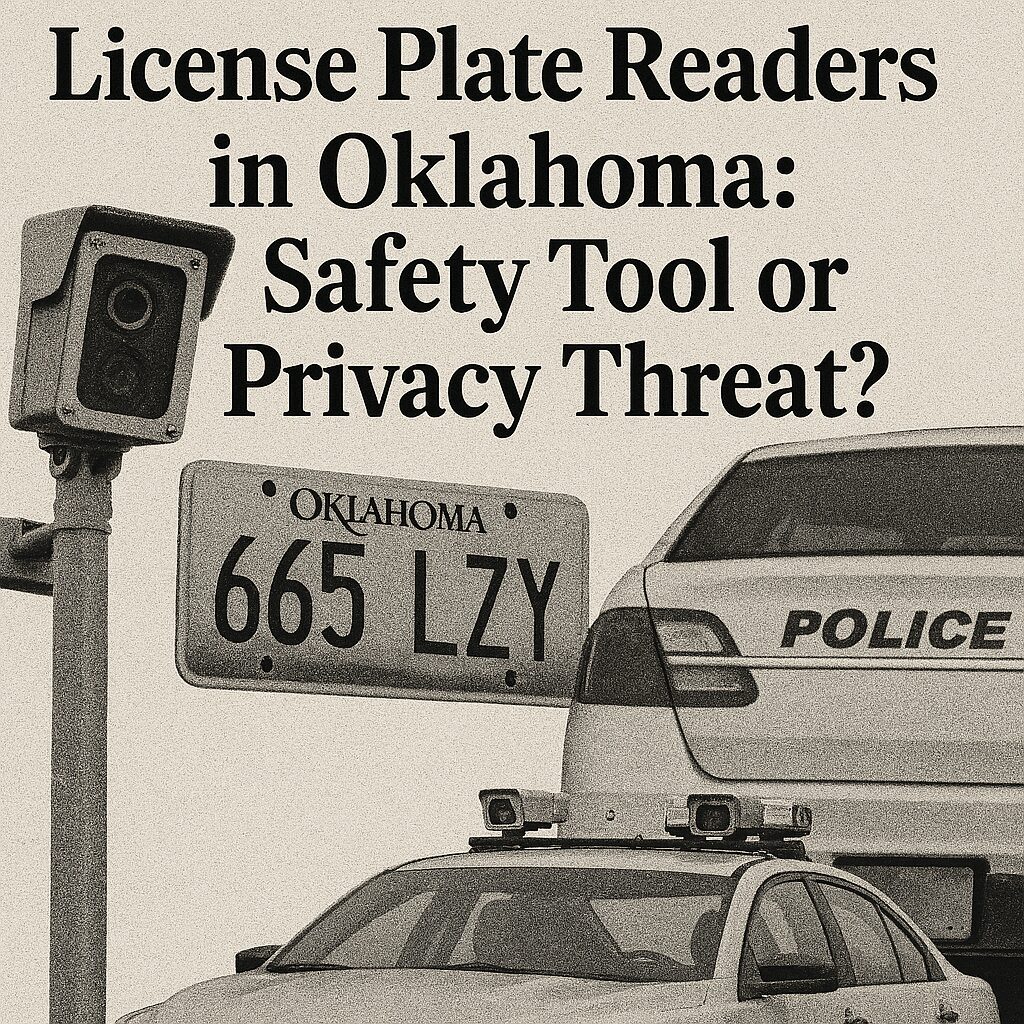
Police say they’re essential for solving rimes. Civil rights groups say they’re creating a surveillance state. Here’s what you need to know.
OKLAHOMA CITY, OK – Let’s play a quick game. Next time you drive to the grocery store, pick up the kids, or head to your place of worship, count the cameras. Not just the red-light ones. Look for small, sleek boxes on telephone poles, or special units on police cars.
Chances are, you missed a few. And every single one of them just logged your license plate, your location, and the exact time you were there.
This isn’t a scene from a spy movie. It’s everyday life in Oklahoma, thanks to the quiet explosion of Automatic License Plate Readers, or ALPRs.
What Are These Things, Anyway?
Think of ALPRs as super-fast, nosy librarians for license plates. They’re high-speed cameras that snap a picture of every plate in sight. In a flash, they record the plate number, plus the time, date, and GPS coordinates.
That information gets zapped to a massive digital database. Police can check it against “hot lists” for stolen cars or missing persons. But here’s the kicker: they also save all that data. For days, months, or even years. They’re not just looking for bad guys; they’re keeping a diary of where everyday Oklahomans drive.
The Good News: Cops Love These Things (For Good Reason)
Police departments across the state will tell you ALPRs are a game-changer. And they’ve got the receipts to prove it.
- In Owasso last year, these cameras helped cops identify a suspect’s car in a murder case. An arrest followed within hours.
- Oklahoma City Police report they recover stolen cars almost weekly thanks to ALPR hits. In one month alone, they got 47 cars back.
- In Norman, the system helped quickly find a missing elderly person by tracing their car’s path.
“It’s an incredible tool for solving crimes and finding the vulnerable,” a spokesperson for the Oklahoma City Police Department told The Oklahoman.
Basically, if your car gets stolen, you’ll probably be glad these cameras exist.
The Other Side of the Coin: Your Privacy on the Line
But what about the millions of plates read from people not committing crimes? That’s where civil rights groups like the ACLU of Oklahoma sound the alarm.
Their 2022 report, “Digital Stop & Frisk,” laid out the big concerns:
- You’re Always Being Watched: It creates a permanent record of your life. Trips to the doctor, a political rally, a friend’s house, or a mosque or church are all logged. “It’s the equivalent of the government putting a GPS tracker on every single car,” said a policy director at the ACLU of Oklahoma.
- A Danger of Dangerous Mistakes: The systems aren’t perfect. In 2022 in Edmond, police pulled over an innocent family with guns drawn. Why? An ALPR misread one letter on their out-of-state plate. The cops apologized, but the scare was real.
- A Chill on Immigrant Communities: This is the most serious documented impact. Data from these cameras is often shared with federal immigration agencies like ICE. A simple drive to work or school could lead to deportation proceedings. Trust in police plummets, making everyone less safe.
Who Paid For This? (Spoiler: You Did)
You might be wondering, “Did we vote on this?” Nope.
The spread of ALPRs wasn’t approved by the state legislature or a public vote. It was pushed by police departments using money from federal grants, like the Edward Byrne Memorial Justice Assistance Grant (JAG).
The Oklahoma District Attorneys Council hands out these grants. So, while it might not show up on your city’s budget, your federal tax dollars helped buy the cameras watching you.
Other States Are Making Rules. Oklahoma? Not So Much.
States like California and New Hampshire have strict laws. They limit how long data can be kept (often just 60 days) and ban sharing with ICE for immigration enforcement.
In Oklahoma? It’s a wild west. One town might keep data for a month. The city next door might keep it for five years. There is no statewide law setting rules. A bill to create some rules died quietly back in 2014.
What’s Next?
The cat’s out of the bag. ALPRs are here. They solve crimes, but they also track everyone.
The question for Oklahomans is: what are the rules of the road for this new technology? Should we follow other states and set limits to protect privacy? Or is the trade-off for safety worth it?
For now, the decision is being made quietly, camera by camera, in police stations across the state. And every time you drive anywhere, you’re part of the experiment.
How to Dig Deeper Yourself:
You can search your local police or sheriff’s department’s website for their “ALPR Policy” or “Privacy Policy”. You can also contact your city councilor or state legislator and ask: “What is our local policy on ALPR data retention and sharing?” They work for you – don’t be afraid to ask.
SOURCES & FURTHER READING:
- ACLU of Oklahoma’s Full “Digital Stop & Frisk” Report: https://www.acluok.org/en/news/digital-stop-and-frisk
- Oklahoma District Attorneys Council – JAG Grant Award Lists (See PDFs for annual awards): https://www.okdac.org/jag-home/jag-award-lists
- News Report on Edmond Wrongful Stop from The Frontier:nhttps://www.readfrontier.org/stories/a-wrongful-high-risk-traffic-stop-in-edmond-raises-questions-about-police-use-of-license-plate-reader-data/
- Tulsa World Report on Owasso Homicide Arrest Using Flock Camera:nhttps://tulsaworld.com/news/local/crime-courts/owasso-police-use-flock-camera-to-make-arrest-in-man-s-homicide/article_8c2b57b6-9b91-11ed-9ec3-5f4b7b66d7e3.html
- The Oklahoman Report on OKCPD Stolen Vehicle Recoveries: https://www.oklahoman.com/story/news/2022/11/07/oklahoma-city-police-use-license-plate-readers-to-find-stolen-cars/69635741007/
- Vera Institute Report on ALPRs and ICE Data Sharing: https://www.vera.org/downloads/publications/automated-license-plate-readers-local-police-immigration-enforcement.pdf
- Brennan Center for Justice Report on Nationwide ALPR Use: https://www.brennancenter.org/our-work/research-reports/automated-license-plate-readers-state-police-policies-and-2019-data
- Oklahoma Legislature Page for Failed 2014 Bill HB 2808: https://www.oklegislature.gov/BillInfo.aspx?Bill=hb2808&Session=1400


